
The $1 Million Telecom Asset Inventory Problem You Can’t See: How to Stop Paying for “Zombie” Assets
Zombie circuits drain OpEx silently when your telecom asset inventory is broken. See how real-time reconciliation eliminates unused assets and billing waste.

If you run network or infrastructure for a telecom, you probably know this feeling.
On paper, you’re paying for 10,000 circuits. In reality, a few hundred of them belong to decommissioned equipment, retired services, or people who left the company years ago. The traffic is gone, but the charges are still real. If 500 of those unused circuits average just $200 a month, that is $100,000 a month, or $1.2 million a year, for services no one is actually using.
Those “zombie” assets quietly drain OpEx month after month. They also make every audit harder. No one can say with confidence which circuits, devices, licenses, and IP ranges are truly in use, which are stranded, and which should have been shut off long ago. This is exactly where a modern telecom asset inventory matters.
Industry analyses back this up. Infosys BPM estimates that organizations can save 12–20% of telecom expenses simply by identifying unused services, billing errors, and redundant lines.
WanAware’s 2025 ITAM survey, Closing the ITAM Confidence Gap, found that organizations report up to 25% of IT spend is wasted on “ghost assets” and unused licenses, a pattern that shows how quickly missing pieces in the inventory turn into real money out the door.
This isn’t a bit of housekeeping you can squeeze in between projects. It’s a direct hit to telecom OpEx, and it chips away at confidence in every budget, forecast, and report that depends on the inventory being right.
WanAware Asset Inventory is designed to stop that leak. You can learn more about the capability on the WanAware Asset Inventory page.
Why Telecom Asset Inventory Audits Always Miss the Ghosts
If zombie assets are so expensive, why are they so hard to kill? Because most telecom environments are built on disconnected systems.
1. The “silo wall” problem
The data you need to answer “Should we still be paying for this?” lives in three places:
- Network monitoring and discovery tools
- HR and decommissioning systems
- Billing platforms and vendor invoices
Each is accurate in its lane, but they rarely align. The result is a fragmented telecom asset inventory that no one fully trusts.
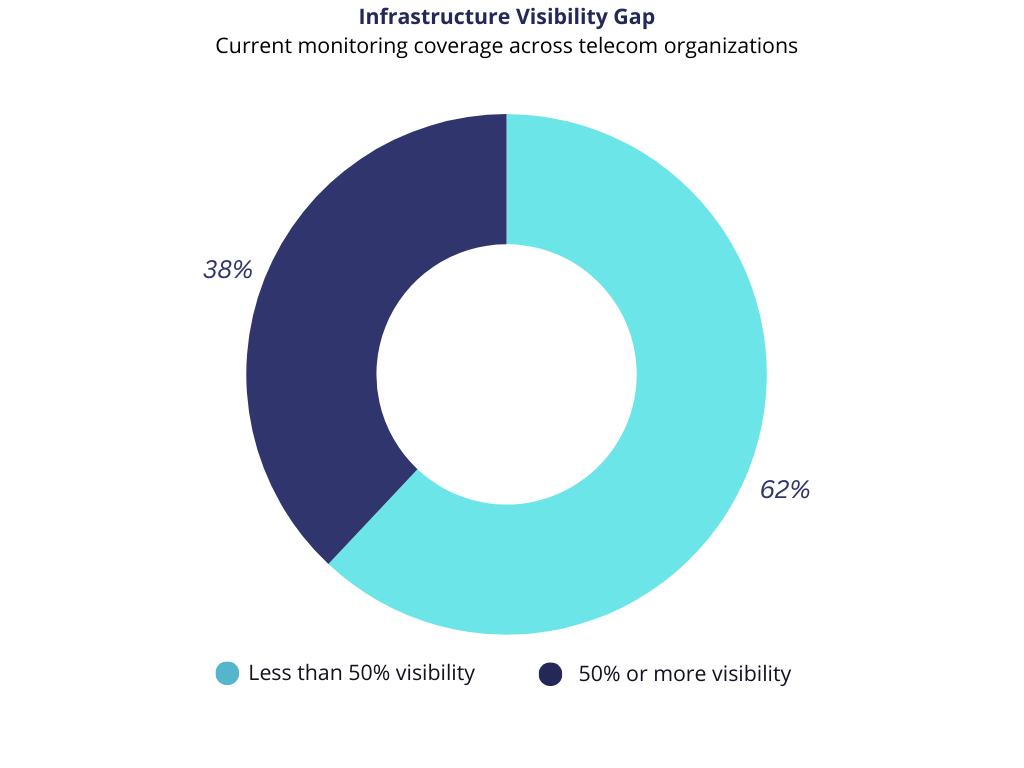
In WanAware’s 2025 Telecom Observability Benchmark, 62% of telecom leaders said their monitoring tools can see less than half of their infrastructure assets, a visibility gap large enough for zombie assets to thrive undetected.

2. The logical inventory blind spot
Telecom environments are uniquely vulnerable to invisible leakage:
- Reserved IP ranges
- Orphaned trunks and unused paths
- Licenses tied to former employees or closed sites
Traditional CMDBs were built for hardware, not logical capacity, so logical assets often disappear from operational views while still appearing on invoices. That makes accurate telecom billing accuracy nearly impossible.
3. The manual trap
When billing reviews depend on spreadsheets, email threads, and one-off exports:
- Reviews happen annually instead of continuously
- Knowledge becomes tribal and dependent on a few people
- By the time you finish the audit, the environment has already changed
Zombie assets don’t stand still. But the tools used to find them often do.
The Fix: Real-Time Reconciliation with WanAware Asset Inventory
Stopping zombie spending requires more than a spreadsheet. It requires a living telecom asset inventory that keeps all the silos in sync and makes it easy to ask, “What are we paying for that we no longer use?”
This is where WanAware Asset Inventory becomes the central system of record.
A continuously updated network reality check
WanAware uses continuous, agentless discovery to maintain a real-time asset inventory across data centers, cloud platforms, and networks.
You see live records of:
- Physical devices
- Virtual resources
- Logical objects (circuits, IP blocks, licenses, subscriptions)
This becomes your network reality check: what is actually present and in use in your telecom asset inventory.
For a telecom-specific deep dive into discovery, read our companion blog, Telecom Asset Discovery: Unlock Real OpEx Savings.
Context that connects assets to people and money
Discovery alone isn’t enough. WanAware enriches each asset with:
- Ownership and HR data
- Lifecycle signals (change records, decommissioning tickets, retirement sign-offs)
- Billing and contract records
This is where the inventory becomes a financial control, not just a list, and where better telecom billing accuracy translates into measurable telecom OpEx savings.
An automatic “leak detector” for zombie assets
WanAware automatically flags mismatches:
- Paid but inactive: Appears on invoices but not on the network
- Assigned but orphaned: Licenses tied to closed sites or exited staff
- Reserved but unused: Logical capacity attached to decommissioned services
Instead of generating spreadsheets at audit time, your team works from a continuously updated queue of suspected zombies, each with attached evidence.
A single source of truth everyone trusts
Traditional CMDBs force each team to maintain its own copy. WanAware replaces that model with one shared, real-time inventory used by:
- Network & infrastructure
- Finance & vendor management
- Security & compliance
As one telecom operator put it:
“With WanAware, we do not find assets. We confirm them.”
If you want to see how inventory fits alongside discovery and remediation, you can explore the broader WanAware AIM module from the main products area of our site.
Beyond Cost Cutting: 3 Strategic Advantages of Accurate Inventory
Eliminating zombie assets creates immediate savings, but the strategic gains go much deeper.
1. Audit readiness, every day
With a real-time telecom asset inventory, you can show auditors:
- The system of record
- The queries used
- The criteria defining in-scope assets
It’s the difference between scrambling to reconstruct and replaying a documented search.
2. Smarter capacity planning and CapEx avoidance
A clean inventory reveals:
- Unused or stranded capacity
- Misclassified assets
- Opportunities to consolidate instead of purchase
This reduces unnecessary upgrades and surprise expenses, and turns telecom asset management into a driver of smarter investment rather than an afterthought.
3. Cleaner migrations and modernization
During 5G, fiber, or data center modernization:
- Zombie assets get left behind
- Only active, needed services migrate
- Teams avoid dragging legacy waste into new environments
If you want a broader view of how visibility impacts outages, modernization, and AI-readiness across telecom, read our whitepaper: Staying Ahead While Enabling Innovation: Intelligent Observability for Modern Telecom Providers.
For cross-industry leaders who want to understand why visibility is a strategic advantage beyond telecom: Why IT Asset Visibility Is Your Company’s Strategic Edge.
From Reactive Audits to Proactive Profit
Zombie assets are a quiet problem with a very loud impact on telecom OpEx savings. They hide in billing systems, legacy logs, and outdated inventory records, eroding margins while the organization assumes the inventory is “close enough.”
They are also completely avoidable.
By moving to a real-time telecom asset inventory enriched with business and billing context, you turn reactive audits into ongoing financial control. You know what exists, who owns it, what it connects to, and what it costs.
You cannot manage what you do not know exists. WanAware gives you a single inventory you can trust, so you can stop paying for assets that deliver zero value.
Prefer to stay in research mode? Bookmark the page and use it as your baseline when you review circuits, licenses, and IP ranges next quarter.