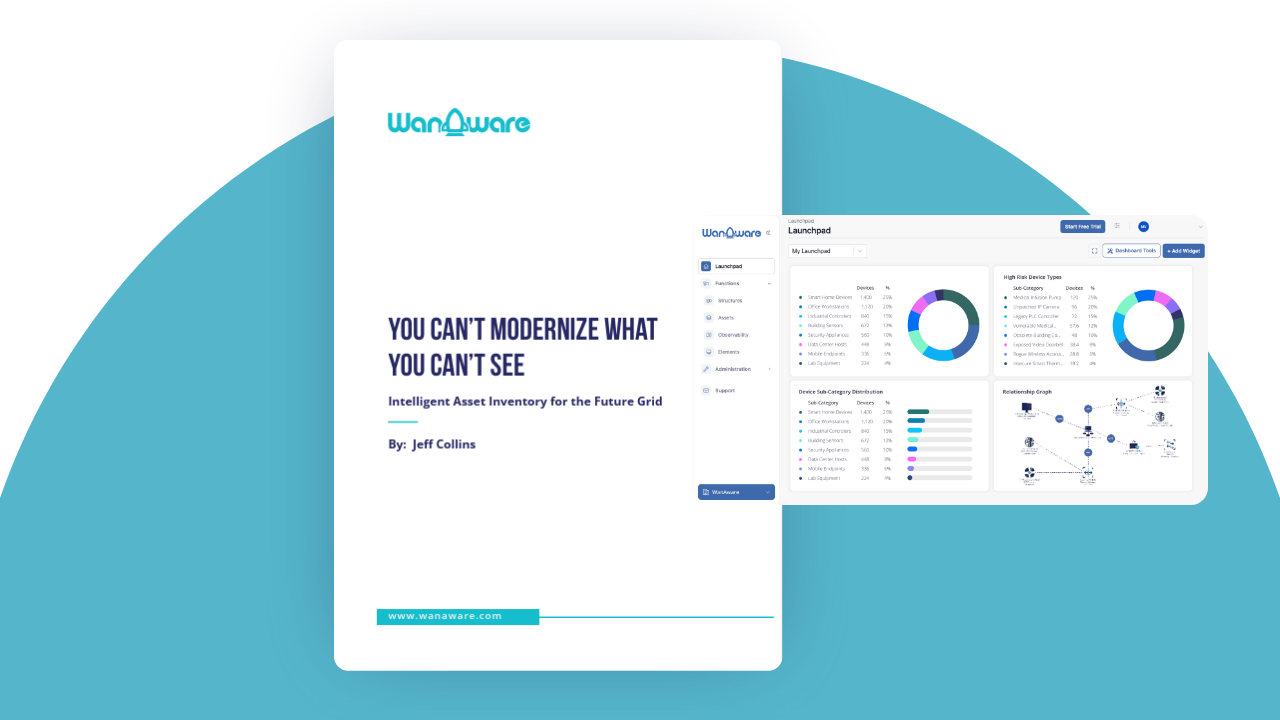
You Can't Modernize What You Can't See
Intelligent Asset Inventory for the Future Grid

Utilities Need Visibility to Deliver Resilience
- The race to net zero is creating dangerous blind spots in aging infrastructure¹².
- DERs, digitization, and climate events are overwhelming static records and siloed tools²˒³˒⁴.
- WanAware AIM gives utilities real-time asset intelligence, risk modeling, and compliance support.
The State of Utility Infrastructure: Caught Between Mandate and Mayhem
Utilities today are being pulled in two directions: they must rapidly modernize to support a more digital, decentralized, and decarbonized grid while still relying on outdated tools and infrastructure that were never designed for today's complexity.
On one hand, the push for decarbonization is driving record investments in renewable energy, DERs (Distributed Energy Resources), and electrification. On the other, utilities are being asked to integrate and manage this complex, high-speed, bidirectional grid with infrastructure and information systems built in simpler times.
Older infrastructure is still the foundation for large portions of the U.S. grid, much of it built for single-direction power flow and 20th-century demand patterns.¹ Many transmission and distribution assets pre-date modern sensing and communications, complicating real-time visibility.¹˒²
Meanwhile, the grid is being reshaped by new forces:
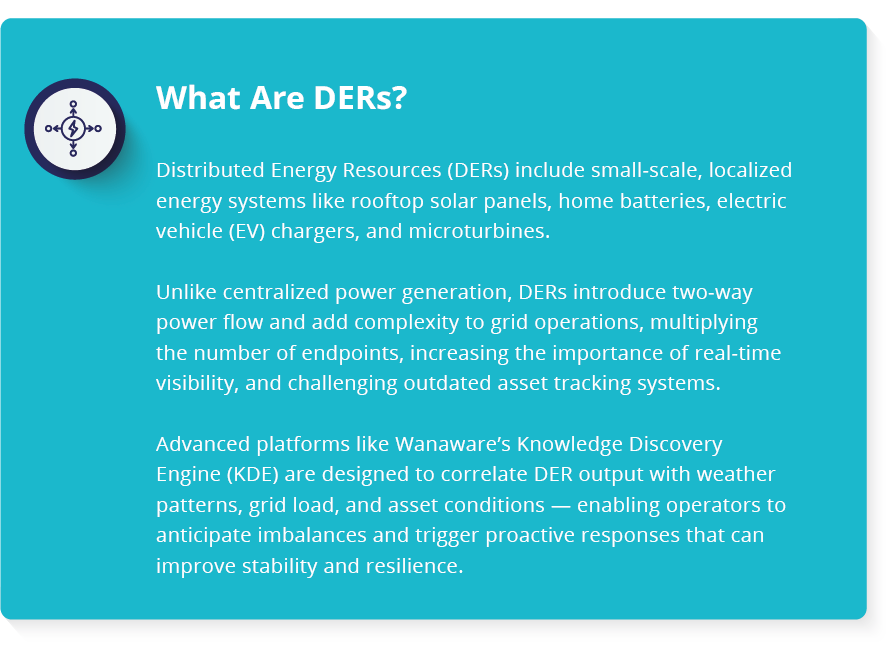
- DER proliferation is decentralizing the grid, introducing more assets to track, more points of failure, and more complexity.²˒³
- Climate change is pushing infrastructure beyond its limits, with extreme events becoming more frequent and intense. About 80% of large U.S. outages since 2000 were weather-related.⁴
- Digital expectations are rising across sectors, from hospitals to AI data centers to EV charging networks, all relying on uninterrupted power and digital transparency.
- Public scrutiny and regulation are intensifying, requiring auditable records, real-time insights, and justifiable investment decisions.
It's not just about keeping the lights on. Utilities are now expected to drive innovation, resilience, sustainability, and trust, all while working with tools that weren't built for the job. Spreadsheets, siloed CMMS tools, and paper-based audits cannot support a grid in constant motion.
To lead in this environment, utilities need infrastructure intelligence: always-on, context-rich, and accessible to every team. That starts by eliminating asset blind spots.
Three Blind Spots Holding Utilities Back
1. You Don’t Know What’s Out There
The number of assets on the grid is exploding, from smart meters and remote substations to private solar arrays, EV chargers, and utility-owned field devices. Many are mobile, intermittently connected, or managed by third parties, yet most tracking systems are anything but modern.
Utilities are still relying on:
- Static inventories built from occasional walkdowns instead of live data
- Disconnected databases maintained separately by field teams, planners, and executives
§8386/§8386.3, utilities must submit Wildfire Mitigation Plans and undergo Energy Safety audits (California Public Utilities Code, 2024).⁶ Accurate, up-to-date asset data makes compliance easier and reduces audit risk.
Even today, many utilities can’t quickly answer basic questions such as:
- What assets were added in the last 90 days?
- Which vendor owns which DER site?
- What firmware version is deployed on edge devices in Zone C?
These aren’t small oversights. They are foundational blind spots that weaken resilience, safety, and compliance.
2. You Don’t Know What’s at Risk
Even when utilities have an inventory, they often can’t tell which assets are most critical or which failures will cause the biggest impact.
The problem isn’t the number of alerts. It’s knowing which ones matter.
A temperature spike on a remote voltage regulator might affect a single feeder. A failed SCADA node in a substation could knock out service to an entire hospital district. Without clear context, every red light looks urgent.
Why It Matters:
- Field crews waste hours chasing low-impact issues while high-impact risks wait.
- Operations teams face “alarm fatigue,” where critical alerts get buried in the noise.
- Executives can’t accurately weigh risk when planning capital or maintenance budgets.
- Crews lose time troubleshooting side effects.
- Regulators and customers lose confidence when “fixes” cause new problems.
Predictive modeling and dependency mapping give operators the confidence to act quickly while minimizing unintended consequences.
Recent Example:
In 2024, a Midwestern utility’s rate case was delayed six months after regulators discovered documentation gaps for key transmission assets. The absence of clear impact mapping made it difficult to prove maintenance priorities and spending justification.
Understanding blast radius, which systems, customers, or services will be affected by a given failure, lets teams focus on the small number of issues that matter most.
3. You Don’t Know How to Fix It Without Breaking Something Else
Even when a utility spots a problem, resolving it without causing new issues can be tricky. A transformer replacement, switch reconfiguration, or software update might fix one fault, only to trigger a failure somewhere else.
The Risk: Modern grids are deeply interconnected. An asset that looks isolated on paper may be tied into multiple feeders, backup systems, or control schemes. Without knowing those dependencies, even routine maintenance can have unexpected consequences.
Example: A voltage regulator upgrade at one Midwest substation caused a chain reaction that tripped feeders serving a water treatment facility. The project team had no view of the regulator’s downstream ties until the outage occurred.
Why It Matters:
- Planned work can turn into costly unplanned outages.
What Needs to Change
Solving these three blind spots requires more than new tools, it takes a new way of thinking about grid visibility and control.
For decades, utilities have focused on monitoring individual assets and reacting to alarms. That approach is no longer enough. Today's grid demands intelligent observability: a real-time, contextual view of every asset, its condition, and its dependencies, plus the ability to act before small problems become big ones.
To get there, utilities need to evolve in three key ways:
- From static records to dynamic discovery. Static inventories can’t keep up with the pace of grid change. Utilities need always-current asset maps that update automatically.
- From alert volume to impact-based prioritization. Not all issues carry the same risk. Operators need to know which ones could affect critical customers, services, or safety.
- From reactive repairs to predictive, low-risk fixes. Modeling and testing changes before deployment helps avoid the side effects that cause outages and erode trust.
This shift isn’t just about technology. It’s about reducing uncertainty, improving resilience, and giving operators the confidence to make fast, informed decisions.
How WanAware Helps
WanAware gives utilities a way to move from reactive firefighting to proactive, data-driven decisions. The platform is designed to meet operators where they are, working with both modern and legacy systems, and to grow with them over time.
1. Discover and Understand Your Infrastructure (AIM)
With Asset Inventory Management (AIM), you can build a complete, real-time map of every asset in your environment, from substations and feeders to distributed energy resources (DERs) and sensors. AIM integrates with existing systems or discovers assets automatically, even in environments with limited documentation.
The result is a living inventory that reflects changes as they happen, eliminating the static spreadsheets and siloed databases that hide risk.
- Spot a new DER before it destabilizes a feeder
- Auto-inventory equipment in remote substations or storage sites
- Detect firmware drift before it becomes a compliance risk
See how quickly you can replace outdated records with a complete, up-to-date view.
2. Quantify Impact and Prioritize What Matters (KDE)
Once AIM has laid the groundwork, the Knowledge Discovery Engine (KDE) adds context. It maps dependencies between assets and calculates the “blast radius” of a failure in real time, helping you see not just that something is wrong, but how many customers or services are at risk.
This lets operators focus on the alerts that truly matter instead of getting buried in noise.
- Link DERs to specific feeders and communities
- Visualize the impact of a key transformer failure
- Understand which SCADA alerts are tied to which edge devices
3. Resolve with Confidence (KDE + Digital Twin)
WanAware builds a digital twin of your environment so you can model and test changes before deploying them. You’ll know whether replacing a piece of equipment will fix the problem or trigger another downstream.
- Identify shared assets critical to multiple systems
- Spot potential firmware risks and orphaned devices
- Prioritize repairs based on exposure and connectivity
4. Enable Automated Remediation (Remediation Module)
With blast radius quantified and changes tested, WanAware can take the final step: automated fixes for recurring problems. When configured, the system can dispatch field crews, reconfigure equipment, or notify customers without operator intervention, freeing skilled staff to focus on high-impact work.
The Payoff: Intelligent Observability in Action
With WanAware, utilities gain the visibility and control needed to manage a modern, complex grid without losing sight of day-to-day reliability.
You’ll be able to:
- Maintain an always-current inventory of assets across generation, transmission, and distribution.
- Spot the issues that truly matter, based on impact and dependencies, instead of chasing every alert.
- Model potential failures in advance to prevent cascading outages.
- Respond faster, with fewer manual steps and less uncertainty.
- Free up skilled staff to focus on modernization and strategic projects.
See it for yourself.
In your first 30 days with WanAware AIM, you can automatically discover assets, map them to real-world locations, and uncover risks you didn’t know were there. Whether it’s a remote substation, a shared feeder, or an aging control system, you’ll see where the blind spots are, and have the data to start fixing them.
References:
¹ U.S. Department of Energy. Grid Modernization Strategy 2024. Washington, D.C.: U.S. Department of Energy, December 2024.
Available at:
Grid Modernization Strategy 2024
² U.S. Department of Energy. Distributed Energy Resource Interconnection Roadmap. Washington, D.C.: U.S. Department of Energy, January 2025.
Available at:
Distributed Energy
³ Deloitte, Digital Utility Asset Management: Managing an Expanding and Complex Asset Mix, Deloitte Insights, February 2021.
Available at:
Deloitte
⁴ Climate Central. “Weather-Related Power Outages Rising.” Climate Central, April 24, 2024.
Available at:
Climate Central
⁵ North American Electric Reliability Corporation. Final Report on the August 14, 2003 Blackout in the United States and Canada. (2004), Chapter 5, failure of EMS alarm system.
Available at:
North American Electric Reliability
⁶ California Public Utilities Code §§ 8386–8386.3 (2024).
Available at:
California Public Utilities Code