
Asset and Relationship Observability for MSPs and MSSPs
Asset and relationship observability helps MSPs and MSSPs see systems, dependencies, and root causes across hybrid infrastructure environments.

How partners gain visibility across complex client environments
Asset and relationship observability helps MSPs and MSSPs see both the systems in a client environment and the dependencies between them. Asset and relationship observability means seeing what assets exist across the environment and how those assets connect to each other. In modern hybrid infrastructure, that visibility helps teams trace outages, identify root cause, and understand what else may be affected.
Traditional observability tools can show symptoms such as latency, failed requests, and application errors. They do not always show which upstream dependency triggered the problem. For MSPs and MSSPs, that difference matters when a client asks a simple question during an incident: Where did the problem start?
Providers that can answer that question more clearly are often better positioned to investigate complex issues, explain findings to clients, and support higher-value infrastructure and security services. This article explains how asset discovery, relationship mapping, and dependency visibility help partners work more effectively across complex client environments.
Key takeaways
- Asset and relationship observability shows both what systems exist and how they connect.
- Metrics can show symptoms, but dependencies often reveal where a problem began.
- MSPs and MSSPs can use this visibility to investigate outages, review exposures, and support hybrid infrastructure services.
These capabilities often support services such as infrastructure discovery assessments, dependency mapping, and incident investigation.
What Is Asset and Relationship Observability?
Asset and relationship observability combines two forms of visibility:
Asset visibility shows what systems exist in the environment, such as cloud workloads, SaaS platforms, identity services, network infrastructure, APIs, and internet-facing services.
Relationship visibility shows how those systems connect and depend on each other.
Together, they give MSPs and MSSPs a clearer way to understand how a client environment actually works.
A list of systems is useful, but it does not explain how one service affects another. Relationship visibility adds that context. It helps teams see which systems sit upstream, which depend on shared services, and where failures may spread next.
Why Asset Relationships Matter in Observability
Most monitoring and observability tools focus on metrics. They collect data such as response times, error rates, and system health signals.
That information is useful, but it has limits.
Metrics can tell a team that something is wrong. They often do not explain why the issue started or which connected system caused the visible failure.
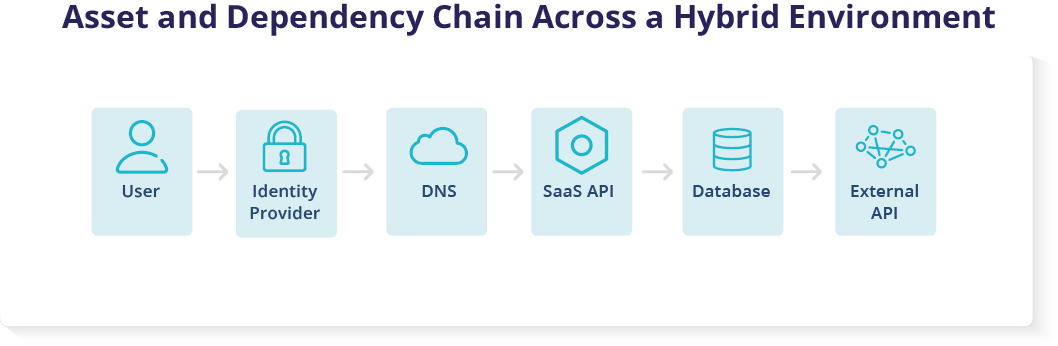
For example, a user may not be able to sign in to an application. The application may show errors, but the root problem may have started in an identity provider, a DNS service, a database, or an external API. If tools monitor those systems separately, engineers may spend valuable time chasing symptoms instead of tracing the source.
Why modern infrastructure makes observability harder
Applications do not operate in isolation. A single user action may depend on several systems working together, including:
- identity providers
- DNS services
- cloud application infrastructure
- databases
- external APIs
The user only sees the final result. When one dependency slows down or fails, the issue may surface in the application even though the failure started elsewhere.
That makes troubleshooting harder for providers supporting hybrid environments across cloud, SaaS, on-prem infrastructure, and third-party services.
Asset discovery is the foundation of observability
Many client environments are only partly documented. Cloud resources are added during new projects. SaaS tools are adopted by separate teams. APIs connect internal and external services. Older systems may remain active long after formal records stop being updated.
That is why WanAware starts with asset discovery across the environment, including:
- network infrastructure
- cloud workloads
- SaaS services
- identity systems
- APIs and integrations
- internet-facing services
From there, relationship mapping adds the next layer of context by showing how those systems connect.
Instead of working from a partial inventory or isolated dashboards, MSPs and MSSPs get a clearer view of both the assets in the environment and the dependencies between them.
How Relationship Visibility Helps Identify Root Cause
During an outage, several systems may show symptoms at the same time. One service may report errors. Another may show timeouts. A third may show failed logins.
The challenge is figuring out whether those alerts point to separate problems or one underlying issue.
Relationship data helps teams answer that question faster. When engineers can see how systems connect, they can identify:
- which system first reported a problem
- which services depend on it
- which downstream systems may be affected
For example, a database failure may trigger application errors, API failures, and user login issues. The visible problem may appear in the application, but the failure may have started in the database. Relationship visibility helps teams trace that path more quickly.
Why Observability Matters for MSP and MSSP Services
Clients rarely call their provider to discuss metrics. They call when something breaks and no one knows where the issue started.
These capabilities can support partner services such as:
- infrastructure discovery assessments
- attack surface monitoring
- hybrid infrastructure troubleshooting
- dependency mapping
- incident impact analysis
For partners, that creates a practical bridge between technical visibility and higher-value services.
How MSPs and MSSPs Use Asset and Relationship Observability
Managed service providers use asset and relationship observability to build a clearer understanding of client environments across multiple platforms and services.
That may include using WanAware to:
- identify the systems running across the environment
- understand how those systems depend on each other
- trace incidents back to the system that triggered them
- see what other systems may be affected
- identify exposed services that need review
This gives partners a better way to investigate client problems, explain what they find, and support ongoing infrastructure and security services.
See how MSPs turn this visibility into services
Asset and relationship observability helps partners understand how systems connect across hybrid environments. That makes it easier to investigate incidents, understand dependencies, and identify exposed services.
See how MSPs turn this capability into practical client services.
Related topics